
A good walking pace for most adults is about 3 mph or faster, which counts as brisk, moderate-intensity walking. Harvard places moderate effort at roughly 2.5–4.2 mph, so you don't need one exact speed. Use the talk test: you can hold a conversation but can't comfortably sing. Adults aged 45–69 average 2.6–2.7 mph, while those 70+ average 1.8–2.0 mph. Below, you'll see how to measure your own pace and why consistency matters most for health.
Key Takeaways
- A good walking pace for health is brisk, moderate-intensity walking, generally around 3 mph or faster.
- Harvard places moderate-intensity walking at roughly 2.5–4.2 mph, so brisk effort matters more than one fixed speed.
- Adults aged 45–69 average about 2.6–2.7 mph, while adults 70 and older typically walk about 1.8–2.0 mph.
- The talk test confirms brisk pace: you can hold a conversation but would find singing difficult.
- Measure your pace by dividing distance by time on a flat route, such as 1.5 miles in 30 minutes equaling 3 mph.
What is a good walking pace
A good walking pace is generally one that reaches moderate intensity, which most health guidance equates with a brisk walk. No single speed suits everyone, but research summaries commonly describe around 3 mph or faster as brisk, though Harvard places moderate-intensity walking at about 2.5–4.2 mph. For context, adults aged 45–69 average about 2.6–2.7 mph, while those 70 and older typically walk roughly 1.8–2.0 mph.
Because walking ability varies, you don't need to hit a fixed number. Use the talk test instead: at moderate intensity, you can hold a conversation but can't sing comfortably and may need occasional extra breaths. If you can sing easily, speed up. If you can't speak more than a few words, slow down. Then keep it sustainable.
What the average walking speed is by age and fitness
Average walking speed is about 1.17 to 1.21 m/s (2.6 to 2.7 mph) for adults aged 45–69 and about 0.80 to 0.91 m/s (1.8 to 2.0 mph) for adults 70 and older, with poorer physical function linked to slower speeds. Because walking speed declines with age, age-specific data gives a more useful comparison than a single average. Study design matters too, since routes, distances, and test protocols differ. Use these benchmarks to place your pace in context:
Walking speed slows with age, so compare your pace to age-specific benchmarks rather than a single average for all adults.
- Ages 45–69: Women average 1.17 m/s (about 2.6 mph), and men average 1.21 m/s (about 2.7 mph).
- Ages 70+: Median habitual speeds are 0.80 m/s for women and 0.91 m/s for men (about 1.8 and 2.0 mph).
- Fast pace, ages 70+: Median fast speeds reach 1.08 m/s for women and 1.19 m/s for men.
- 4-meter tests: Usual averages fall around 1.13–1.14 m/s.
- Fitness factors: Speed increases with height and education and decreases with poorer physical function.
Treat these figures as group-level references, not personal targets.
What brisk walking means and how fast it is
Brisk walking means walking at a moderate-intensity effort, which health guidance and research summaries commonly place at about 3 mph or faster, rather than at one fixed speed. Harvard's summary puts moderate-intensity walking at roughly 2.5–4.2 mph, so your brisk pace may differ from someone else's. What matters is relative effort: a pace that feels moderately challenging counts, even if it doesn't match a typical mph benchmark.
You can gauge intensity with the talk test. At a brisk pace, you can hold a conversation but can't sing comfortably, and you may need occasional extra breaths. If you can sing easily, you're likely below brisk effort. If you can't speak more than a few words without pausing, you've exceeded moderate intensity. No tracker or speed reading required.
How to measure your own walking pace
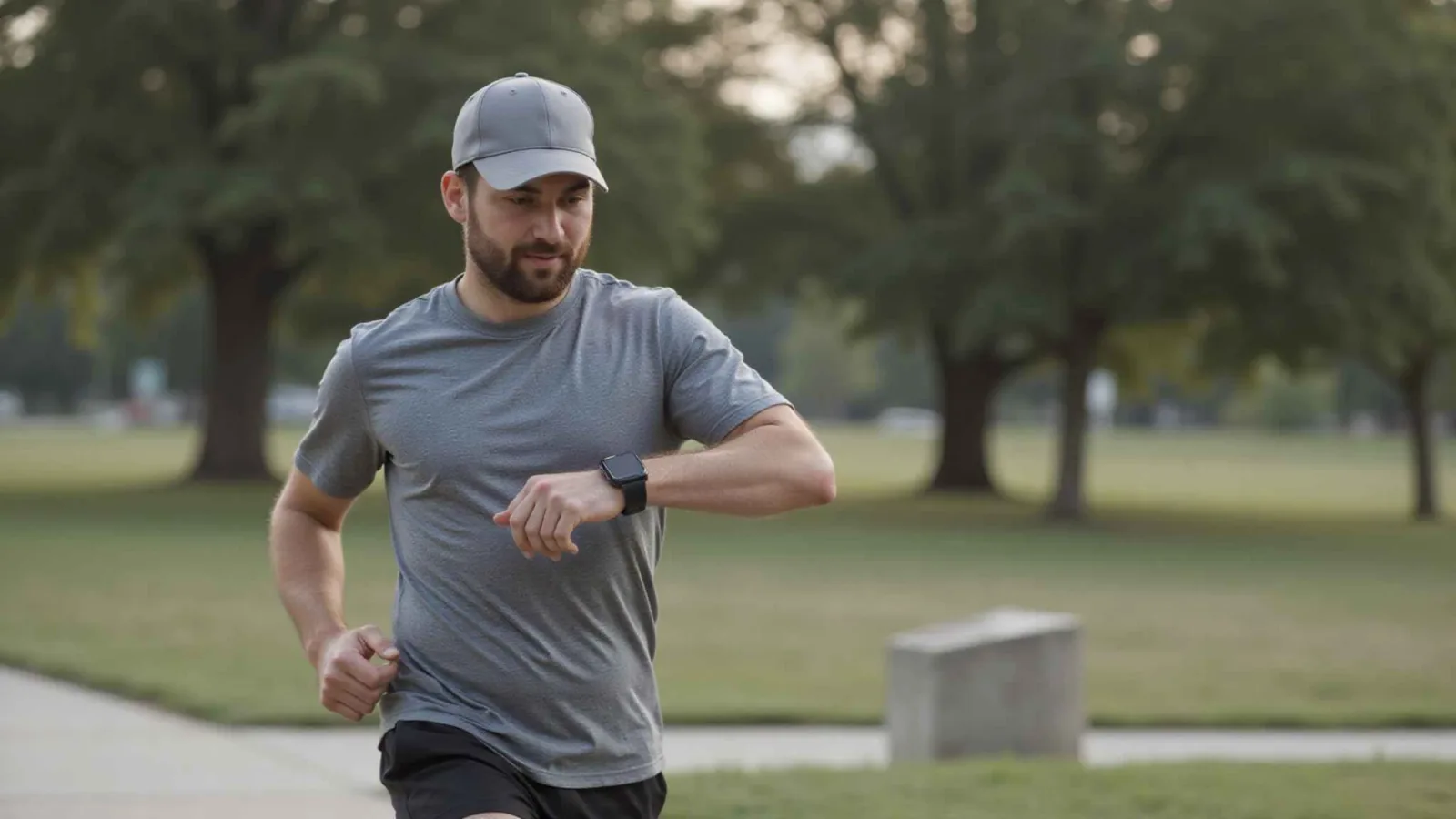 Time yourself over a measured route, then divide distance by time to get your speed. For example, if you cover 1.5 miles in 30 minutes, you're walking 3 mph. You don't need a treadmill or smartwatch, though either can track pace. Use these steps for consistent results:
- Pick a flat, measured route, such as a 400-meter track.
- Walk at your usual pace, then repeat at a brisk pace.
- Convert meters per second to mph by multiplying by 2.237.
- Apply the talk test: you can talk but can't comfortably sing.
- Retest monthly and raise your pace gradually.
Compare your results with published averages cautiously, since studies use different distances, populations, and test protocols. Track your trend over time. It's the most meaningful benchmark you have.
How walking paces compare on calorie burn and health benefit
Faster walking paces appear to bring greater health benefits and generally burn more calories per minute, though any regular walking beats none. Research summarized by Harvard found protective benefits at 2.0–2.9 mph compared with not walking regularly, with the greatest benefits at 3 mph or faster. Faster walking raises effort, which generally increases energy use per minute, though exact calorie burn depends on your body size, terrain, and fitness.
| Pace | Talk-test effort | Reported benefit |
|---|---|---|
| No regular walking | Not applicable | Reference baseline |
| 2.0–2.9 mph | Conversation easy to moderate | Protective benefits observed |
| 3+ mph | Talk possible, singing difficult | Greatest benefits observed |
If you're older, raising your speed by 0.1 m/s was associated with improved survival in a pooled analysis of studies. Aim for 150–300 weekly minutes at moderate intensity, if able, using the talk test.
Why pace matters less than consistency for most people
 Pace matters less than consistency because regular walking, not a specific mph, drives much of the benefit for most people. Harvard's research summary found protective benefits for people walking at 2.0–2.9 mph compared with those who didn't walk regularly. Faster walkers, at 3 mph or above, gained the most, but slower pace still counted. Your weekly total is what counts most:
- Aim for volume: U.S. guidelines recommend 150–300 minutes of moderate activity weekly.
- Use the talk test: You should be able to talk, but not sing comfortably.
- Ignore universal targets: Average speeds are group references, not personal goals.
- Build gradually: Increase pace only while effort stays manageable.
- Track trends, not snapshots: Compare your own times on the same route.
Small speed gains can add further benefit after you've built a sustainable routine.
How Steppa tracks your steps at any pace
Steppa records your steps whether you're strolling at 2 mph or walking briskly at 3 mph or faster, so every walk adds to your daily total. Consistency is easier to sustain when you can see it. You don't need a treadmill or smartwatch to judge effort; pair your step count with the talk test. If you can talk but not sing, you're likely at moderate intensity. Review your history to spot patterns across days and weeks, then raise your pace gradually while keeping effort manageable. Remember that pace is a personal reference, not a universal target. U.S. guidelines recommend 150–300 weekly minutes of moderate activity for adults with chronic conditions, if able. Steppa helps you build toward that.
Find Your Pace and Keep Moving
Your ideal walking pace is the one you can sustain consistently while still challenging yourself. Steppa lets you track the steps behind that routine and turn everyday walking into challenges that keep you moving.
Try Steppa or download the app on the App Store.
Frequently Asked Questions
Does Walking Pace Differ Between Treadmill Walking and Outdoor Walking?
Yes, walking pace often differs between treadmill and outdoor walking, and many people choose a slightly slower pace on a treadmill than they do over ground. The size of the difference isn't fixed, because walking-speed results vary by route, distance, and test protocol, so compare figures cautiously. You can track pace on a treadmill or smartwatch, but you don't need either. In either setting, use the talk test: if you can talk but not sing, you're walking at moderate intensity.
How Does Walking Uphill or on Uneven Terrain Affect Pace?
Walking uphill or on uneven terrain typically slows your pace while raising your effort, so your mph won't reflect intensity reliably. Since moderate effort, not one fixed speed, defines brisk walking, use the talk test on hills: you should be able to talk but not sing comfortably. If you can't say more than a few words, you've exceeded moderate intensity. Compare your times only across identical routes, because differing routes substantially distort walking-speed figures.
Sources
Turn the number into a habit
Knowing the target is the easy part. Steppa puts real money behind it: join a challenge, hit your daily goal, and split the pot with everyone who finishes. Free to download, works with the tracker you already own.
Download Steppa4.6★ · 2,812 ratings · 16B+ steps tracked · $4.6M+ paid out